
Certifications and Audits: Are They Necessary to Export?

Certifications and Audits: Are They Necessary to Export?

Certifications and Audits: Are they really necessary for Exporting?

In a globalized and highly regulated market, exporting agricultural and food products faces constant technical challenges. Discover why certifications and audits are the indispensable passport to guarantee food safety.

The Importance of International Standards

In an increasingly interconnected world, exporting agricultural and food products faces complex challenges that go beyond logistics. Certifications and audits have become strategic and indispensable tools to ensure that products meet the rigorous quality and safety standards required by target markets. To the question of whether they are really necessary for exporting, the answer is a resounding yes: they are the pillar that supports trust between producers, regulators, and end consumers.


Pillars of International Verification

  • Certifications – The Passport for Trade: Globally recognized programs, such as GLOBALG.A.P., are essential for products to be accepted in high-demand markets like the European Union or the United States.
  • Audits – Verification and Trust: Detailed inspections carried out by accredited bodies that verify production, handling, and hygiene processes, minimizing the risks of rejection at the border.
  • Inspections at Origin: Many importing countries require in-situ verifications to validate that cultivation practices meet the required standards before shipping.

CEIMIC’s Role in the Export Process:

We understand that maintaining these certifications requires excellent analytical support. Therefore, we offer:

  • ISO/IEC 17025 Accredited Analysis: Results with international validity to support your audit processes.
  • Contaminant Monitoring: Detection of pesticide residues and heavy metals according to global legal limits.
  • Specialized Technical Advisory: Expert support in interpreting the analytical requirements for each certification.

Ensure the success of your exports by complying with the highest international standards. For technical inquiries or analysis services, contact us at: info@ceimic.com


CEIMIC. Life Sciences Testing Group. It’s about life.

Official Border Controls of the European Union: Everything You Need to Know

Official Border Controls of the European Union: Everything You Need to Know

Exporting to the European Union: Keys to Regulation (EU) 2017/625 and Official Controls

Food safety and quality are essential priorities in the European Union (EU). To guarantee these standards, the EU has implemented Regulation (EU) 2017/625, which introduces stricter and more coordinated procedures for the inspection of food products, including fruits.

Physical and Documentary Inspections

Inspections at EU borders are carried out by the competent authorities of each member state and include:

  • Physical and documentary inspections: Documentation is verified and a visual analysis of the products is performed.
  • Laboratory analysis: Tests are carried out to detect pesticide residues, microbiological contaminants, and other potential risks.

Physical Inspections

Regulation (EU) 2017/625 establishes several mandatory physical inspections:

  • Control of animals and goods: This includes visual and physical inspection of animals and products.
  • Control of packaging and means of transport: The condition and adequacy of the packaging and the vehicles used for transport are verified.
  • Labeling and temperature: Checks are made to ensure labeling is correct and product temperature is appropriate.
  • Sampling for analysis: Samples are taken to perform necessary analyses, tests, or diagnoses.

Documentary Verification

In addition to physical inspections, Regulation (EU) 2017/625 establishes rigorous documentary inspections:

  • Verification of accompanying documents: Certificates, permits, and other documents accompanying the products are checked.
  • Review of records: Records maintained by companies, such as production, transport, and storage, are inspected.
  • Control of import and export documents: Documentation related to the import and export of agri-food products is verified.
  • Management systems audits: Quality and safety management systems implemented by companies are evaluated.

Laboratory Analysis

Laboratory analyses are fundamental for official controls in the agri-food chain:

  • Microbiological analysis: To detect pathogens such as Salmonella, E. coli, and Listeria in food and feed.
  • Chemical analysis: To identify pesticide residues, environmental contaminants, and unauthorized additives. These include:
  • Residue sampling and analysis: Samples of food and feed are taken to analyze the presence of pesticide residues.
  • Maximum Residue Limits (MRLs): Products must not contain pesticide residues exceeding established MRLs.
  • Risk-based controls: Analyses are performed according to a risk-based approach, prioritizing products and substances representing a higher risk to public health.
  • Veterinary residue analysis: To detect residues of veterinary medicines in products of animal origin.
  • DNA analysis: To verify product authenticity and detect genetically modified organisms (GMOs).
  • Plant health testing: To identify pests and diseases in plants and plant products.

At CEIMIC, we have vast experience in pesticide analysis and are recognized for our precision and reliability in residue detection.


We offer a full range of analysis services for agri-exporters wishing to ship their products to the European Union, ensuring they comply with the strict requirements of Regulation (EU) 2017/625.

With our advanced sampling methods and risk-based testing, we help exporters ensure their products do not exceed the established Maximum Residue Limits (MRLs), thus protecting public health and ensuring the acceptance of their products in the demanding European market.


CEIMIC. Life Sciences Testing Group. It’s about life.
Source: https://eur-lex.europa.eu/eli/reg/2017/625/oj/spa

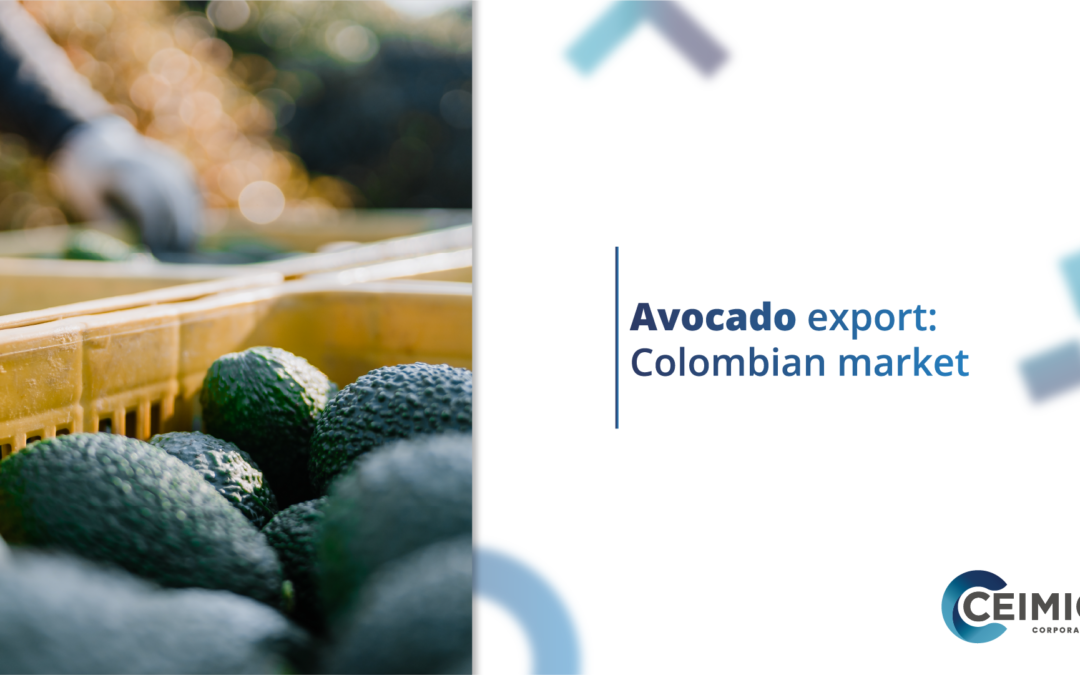
Avocado export: Colombian market

Avocado export: Colombian market

Colombia Begins Avocado Exports to China: CEIMIC’s Analytical Support


Despite recent global challenges, the Colombian agricultural sector is celebrating significant milestones, such as the shipment of the first 24 tons of avocados to China. Colombia currently stands as the world’s fifth-largest producer of this variety, with over 11,237 hectares under cultivation. This progress marks the beginning of a strategic era for national agriculture, which demands rigorous technical support to meet the requirements of international markets.

At CEIMIC, we reaffirm our commitment to exporters by offering specialized services in multi-residue pesticide analysis, data intelligence for emerging markets, and international accreditation. We have a new laboratory strategically located in the center of the country (Chía, Cundinamarca), designed to provide high-precision and reliable results.

Enhance your international competitiveness by contacting us at +57 3103987862.